Foster program software that puts the foster program first
Most animal welfare software manages records and treats fostering as a module. Pawsitive Foster is built the other way around: the foster program is at the core, and everything else, intake, matching, communication, reporting, exists to make it run.
What is foster program management software?
Software that helps animal shelters and foster-based rescues recruit, train, manage, and support foster caregivers, and track every animal from intake through outcome.
Pawsitive Foster does all of it: applications and onboarding, public intake triage, skill-based matching, communication and scheduling, after-hours caregiver support, and reporting.
Onboard new foster volunteers in a day, not a month
Forms and spreadsheets were made for surveys, not for reaching the right person tonight. Applicants sit unanswered, the ones you did reach go stale by the next season, and the person who was ready to say yes stopped waiting weeks ago.
With Pawsitive Foster, you share one application link. Applications arrive in a queue, approve or decline in one action, and approved volunteers onboard themselves in three steps. Profiles stay current because volunteers manage their own preferences and availability, for the first time ever.
Organizations that onboard foster volunteers in under a day place a median of 270 animals a year. For those that take over a month, it's 20 (Maddie's Fund, 2023).
You're choosing to lose the animals you couldn't take
What you're choosing instead: a phone line, a front desk, and whoever picks up. The animals you turn away leave no trace, so the demand your board sees is only the part you had room for.
One front door for found animals, surrender requests, and community inbound, triaged against your criteria and tracked from arrival to resolution with a record of who acted and what's still open. Accepted cases become draft animal records. The ones you can't take stay in your data, where your county and your grantmakers can finally see what's really coming at you.
You're choosing to ask hundreds of people who they are, again
What you're choosing instead: your platform has a foster portal nobody logs into, so keeping the roster true means emailing hundreds of caregivers to ask them about themselves, then calling everyone who doesn't reply, and doing it again next year.
Caregivers keep their own profile current: skills, medical experience, what they'll take, when they're free. A plea for a bottle baby reaches only the people equipped for one, ranked by who's ready now.
You're choosing to dispatch an ambulance through a Facebook group
What you're choosing instead: exactly that. An urgent plea posted where it competes with a fundraiser and yesterday's adoption photos, reach decided by an algorithm nobody at your organization controls, or an email sitting in an inbox next to a Target receipt. At that point you might as well send it by mail. Then the answers scatter across a reply-all, three text threads, and a voicemail, so first come is whoever got read first.
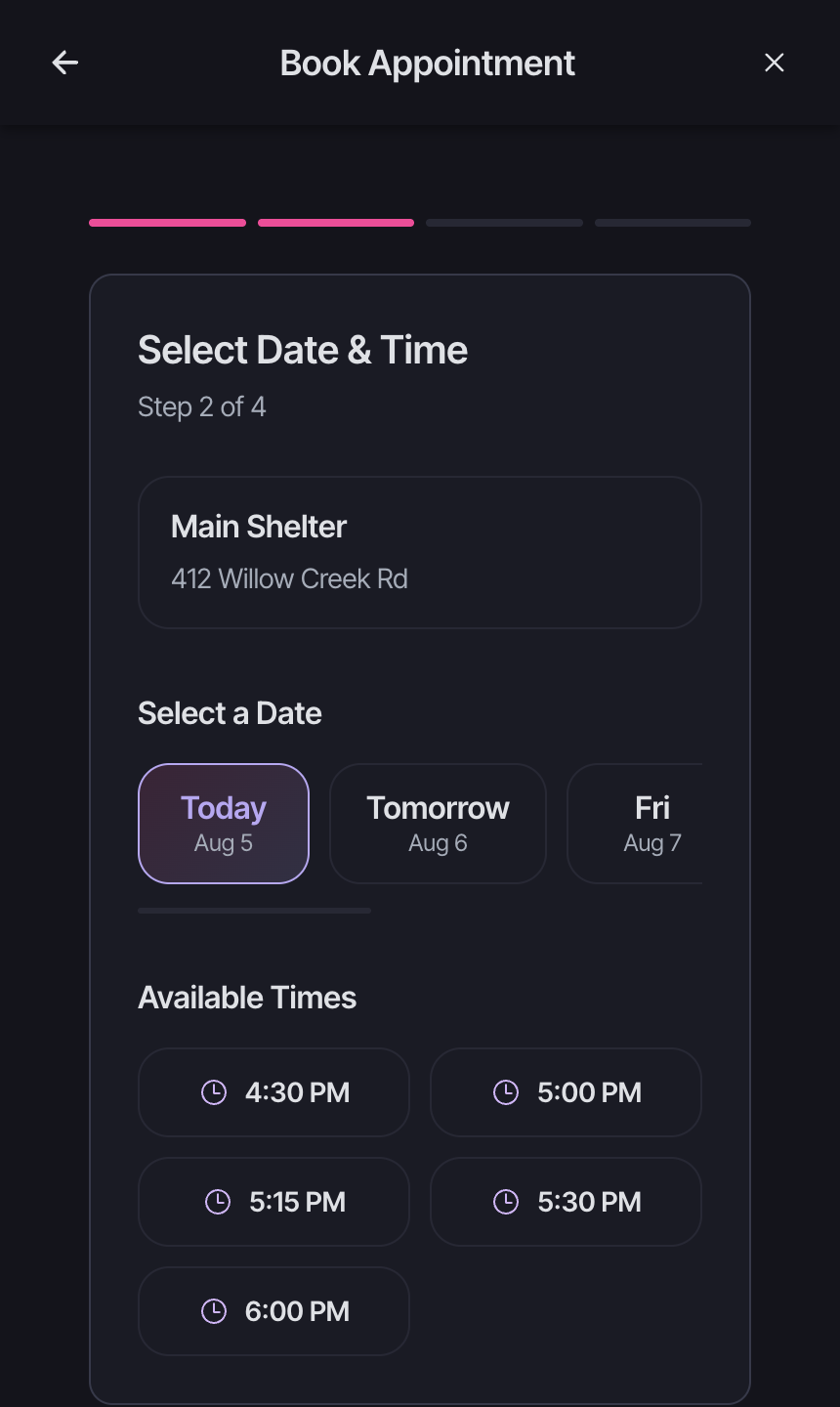
Scan the kennel card, the plea writes itself, and it lands on the right caregivers' phones as a notification. They claim a specific animal or a whole litter. One tap approves it. They book their own pickup against windows you set once.
Intake at 4:50. A caregiver said yes at 5:14. Pickup booked by 5:29.
You're choosing to be the 2am phone number
What you're choosing instead: a personal cell number in an email signature, and a coordinator who hasn't slept through a kitten season in years.
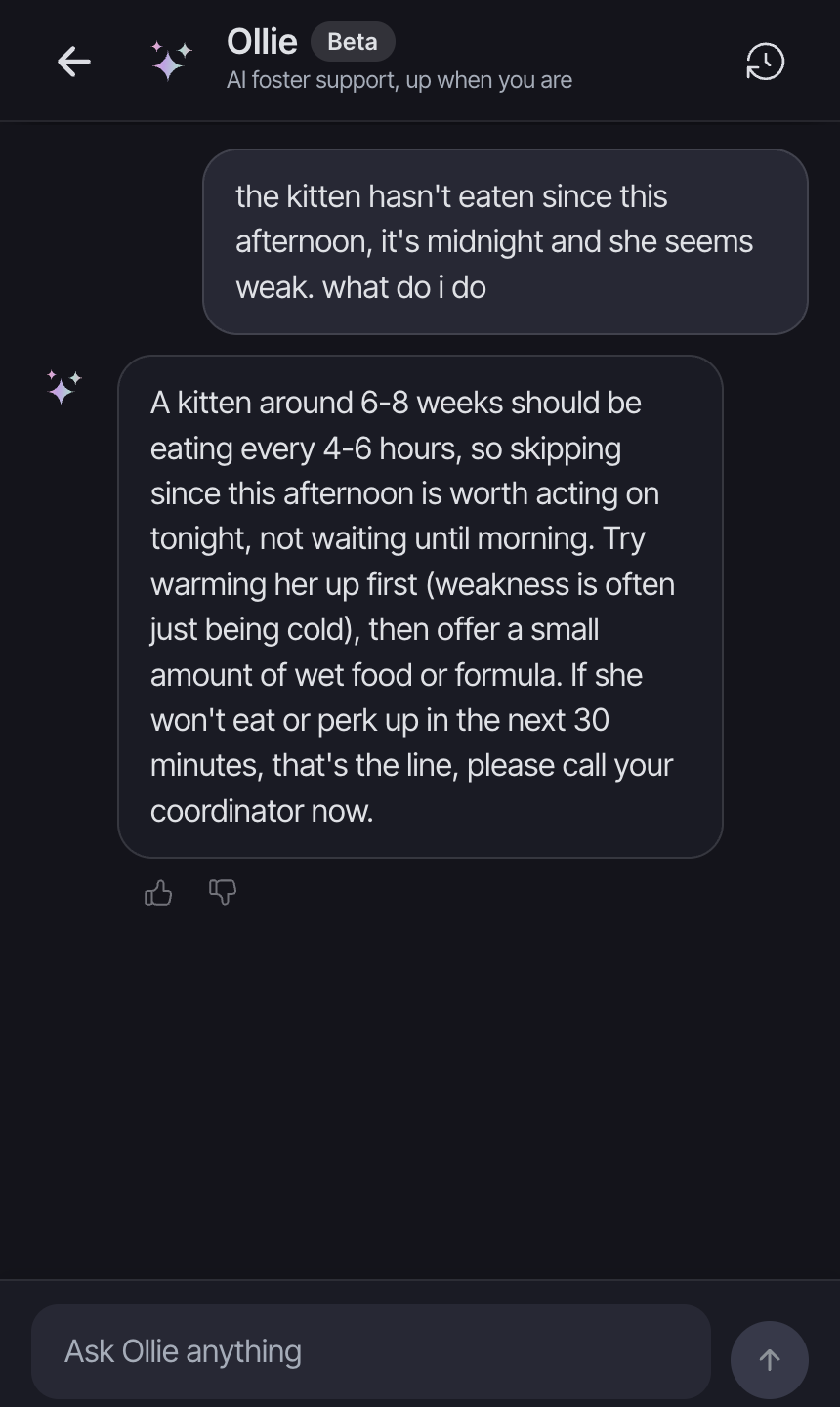
Ollie answers at any hour: feeding amounts by weight, warming and latch troubleshooting, what's worth watching and what's worth moving on. It doesn't diagnose, it doesn't tell anyone what to give, and the moment a question is past what a chatbot should be calling, it hands straight to your coordinator.
Nobody quits fostering because it's hard. They quit because they asked a question at 9pm and nobody answered until Tuesday. The largest study of foster caregiver turnover put communication at the top of what would have kept people fostering (Rogelberg & Williams, 2017).
You're choosing to rebuild the year from memory
What you're choosing instead: rebuilding a year out of three inboxes and somebody's memory, the week the grant is due.
Placements, capacity, response times, and outcomes compile continuously. The board report and the grant application become an export instead of a weekend.
Doing it the old way is a choice now.
The status quo used to be forgivable. The tools didn't exist, the budget wasn't there, and you did what you could with a group text and a spreadsheet. That excuse is gone.
Nobody was going to build this for you
The vendors serving this sector built for records, kennels, licensing, and enforcement, because that's what the checks were for. Foster never generated a fee, so foster never got a system, and coordinators have been covering the gap with their own phones ever since.
Pawsitive Foster exists because the founder was standing in that gap: fostering bottle babies for three Northern California organizations, then shadowing a coordinator at a high-intake county shelter and watching one person hold an entire program together with a phone and a spreadsheet.
Founded by Lissette Arias, foster volunteer and product designer.
Self-serve fosters
Animals, medical needs, care instructions, pickup times, and the foster team. All on their phone, no call required, no waiting on a reply.
“Hace que el proceso de acogida sea más fácil y organizado. Como persona con una discapacidad física significativa, me da acceso independiente a toda la información que necesito.”
Two apps, one system
Coordinators intake, plea, approve, and report. Caregivers get the plea on their phone, claim the litter, book their own pickup, log weights and photos, and ask Ollie a question at 2am.
iOS and Android, both sides.
Nothing to migrate. Nothing to learn.
Add an animal, invite your caregivers, send a plea. Coordinators are placing animals in their first week.
Choose differently before the next litter comes in
You already know which of those you're still doing. Pick one and end it this week.
Set up your organization, invite your caregivers, send a plea. There's no procurement cycle, no migration, and no contract to get out of later.
Free to start, no credit card. Starter is free forever for small rescues.
Preguntas Frecuentes
What is foster program management software?
Software that helps animal shelters and rescues recruit, train, manage, and support foster caregivers, and track animals from intake through outcome. Pawsitive Foster covers applications and onboarding, intake triage, foster matching, communication and scheduling, after-hours caregiver support, and reporting.
What's the difference between shelter management software and foster program management software?
Shelter management systems were built around records, kennels, licensing, and compliance, with foster care management as one module. Foster program management software puts the foster workflow at the center: the caregiver roster, the match, the communication, and the support that keeps volunteers fostering.
Do foster-based rescues need different software than shelters?
The core jobs are the same, but a foster-based rescue has no facility, so the caregiver network is the entire operation. A platform built foster-first serves both. A platform built kennel-first serves neither well.
What should foster management software include?
Caregiver profiles with skills and availability, an application and onboarding flow, plea and response management, messaging, scheduling, and outcome tracking, on an app your caregivers will actually open.
Do foster programs actually improve outcomes?
Organizations with foster programs adopt out 68% of animals on average against 48% without (Best Friends Animal Society, 2026), and foster-based organizations reach 75% against a 56% shelter average (Shelter Animals Count & Pawlytics, 2025).
How do most foster programs coordinate placement today?
Group texts, BCC email lists, and a Facebook group, layered on a shelter system that treats fostering as a checkbox. Consolidating that stack is the point.
Referencias
- Best Friends Animal Society. (2026). Pet foster homes increase adoptions and save more lives. https://bestfriends.org/stories/features/pet-foster-homes-increase-adoptions-and-save-more-lives
- Maddie's Fund. (2023). Dog & cat foster care in the United States: 2022 survey report. https://www.maddiesfund.org/assets/research/Dog-Cat-Foster-Care-Report-2022.pdf
- Rogelberg, S., & Williams, L. (2017). Understanding turnover of foster caregivers. University of North Carolina at Charlotte; Maddie's Fund. https://www.maddiesfund.org/assets/grants/final-foster-turnover-report.pdf
- Shelter Animals Count & Pawlytics. (2025). National trends in foster-based rescue operations. https://www.shelteranimalscount.org/wp-content/uploads/National-Trends-in-Foster-Based-Rescue-Operations_FINAL-2.pdf